
How to Search Criminal Dockets
Figure out the court level first. That choice decides which Limestone County office holds the file. The County Clerk keeps County Court misdemeanor files. The office reports that iDocket carries court information from 1985 forward. District criminal files belong to the District Clerk. Neither clerk's payment page doubles as a full case register. Bring a cause number if you have one. A full name and a rough date range help the clerk tell records apart.
- Check the notice for the court and cause number.
- For a County Court setting, open the dated docket PDF.
- For County Court history, try iDocket and note its sign-in gate.
- For district crime, contact the District Clerk or check re:SearchTX.
- Ask the custodian for the judgment or a certified copy when proof is needed.
Limestone County Docket PDF Index
For upcoming settings, the county posts date-linked entries through its County Court Dockets index. Think of it as a calendar, not a case history. Entries identify dates and sessions. Some dates simply read "No Docket" or "No Cases Set." A listed hearing is never a final result.
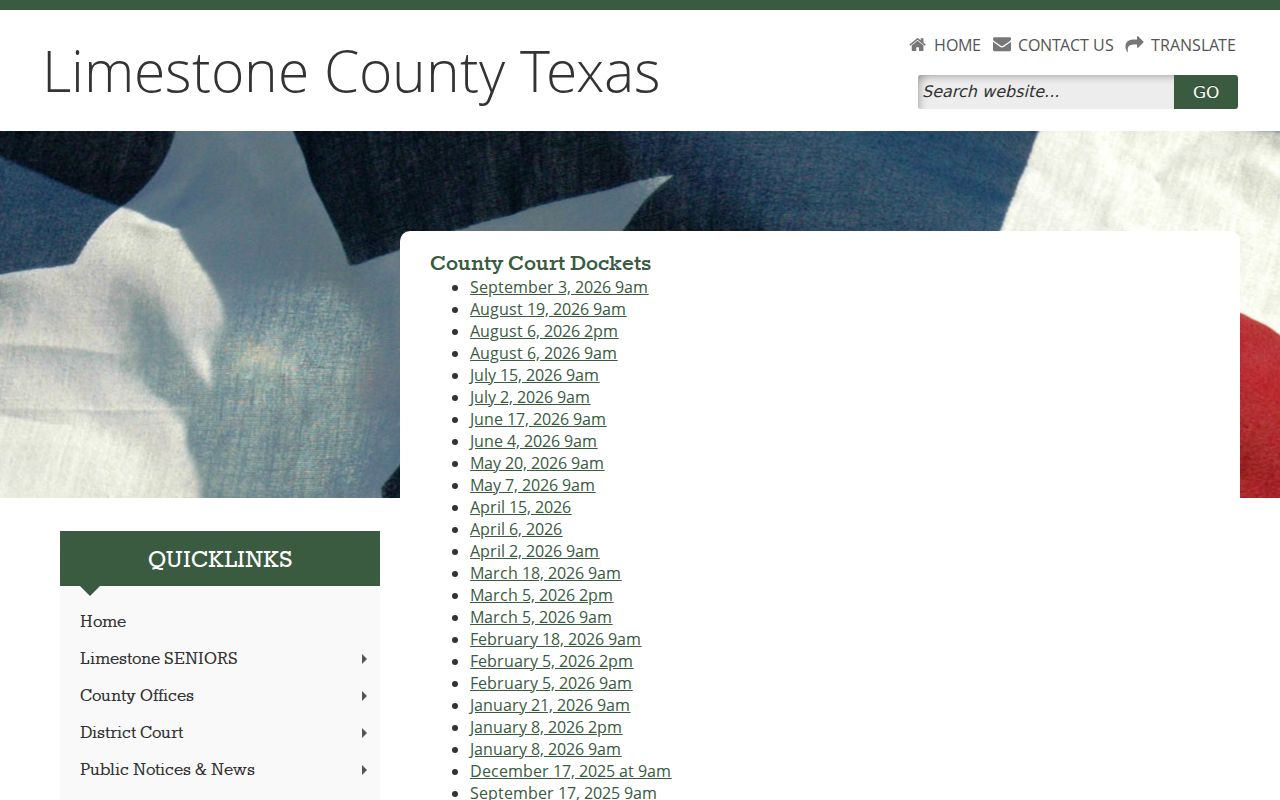
That index is why you check the date and time before opening a PDF. Settings can change without much notice. Confirm the event with the County Clerk before you travel, especially if the saved copy is old.
What a Criminal Docket Shows
A Limestone County setting docket offers a compact preview of what the County Court plans to hear. The sample record listed the court, the judge, the date, the time, and the fields used to organize each matter. Those fields describe an event. They do not replace the filings or the judgment.
| Cause number | The unique case identifier, best used exactly as printed. |
|---|---|
| Offense and degree | The filed charge label and class, not a finding of guilt. |
| File and offense dates | Case initiation and alleged event date. |
| Attorney and bondsman | Representation and release fields that may change. |
| Bond and continuances | Release amount and recorded resets, when shown. |
| Date and time | The scheduled setting, not a disposition. |
A blank field proves little. The item may not apply, may not have been entered yet, or may simply be left out of that calendar format.
Limestone County iDocket Transition
The County Clerk connects its court information to iDocket. The older filed-county index displayed "last new case" dates for the county and district feeds in March 2023. Its notice drew a line between a new-case date and later filings. Those later filings came in an existing case. That distinction matters when you want to know whether the feed is current.
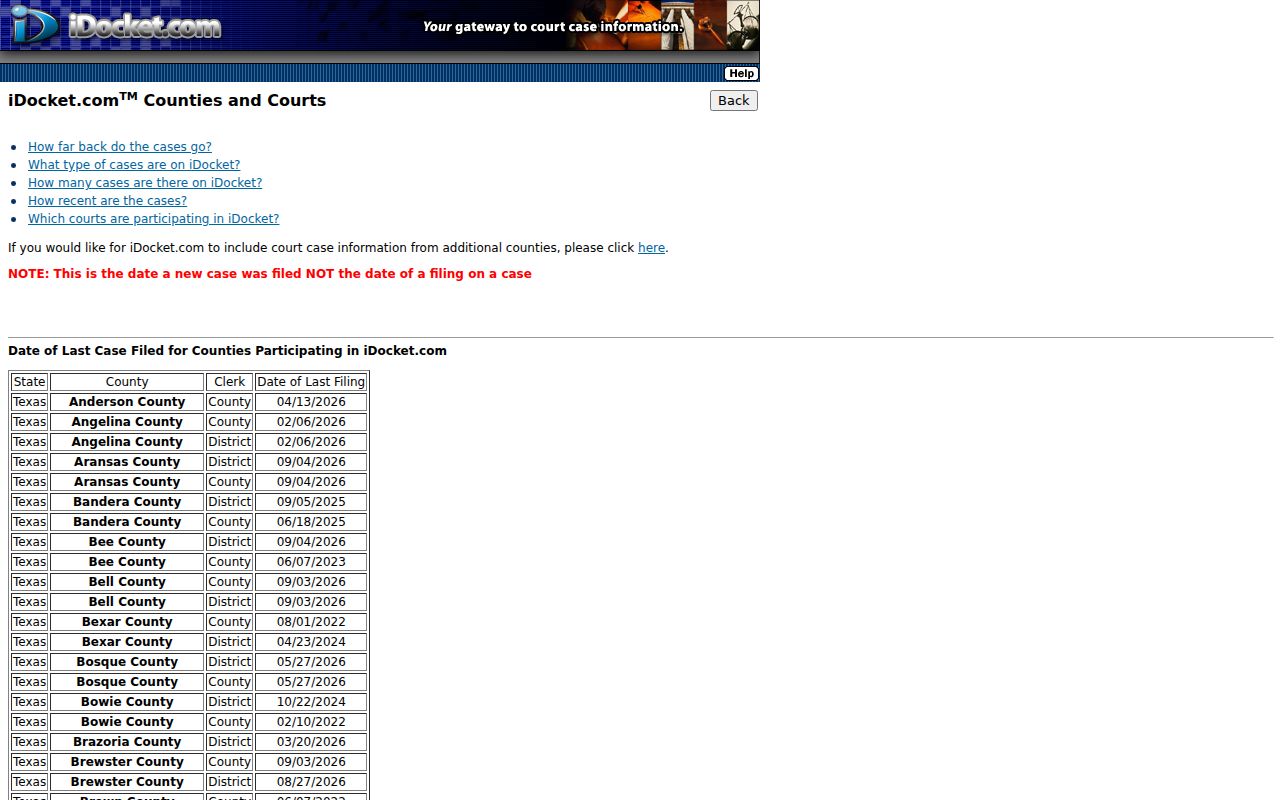
A dated notice is a transition clue, not proof that a case stopped receiving filings. The current iDocket route required registration to test. If a guest search fails, go back to the clerk rather than assuming no record exists.
Stages on a Criminal Docket
Each event on a criminal docket plays its own role. Arraignment addresses the charge and the defendant's response under the applicable process. Pretrial entries may deal with counsel, motions, evidence, or scheduling. A motion to revoke probation is a request tied to an alleged violation. Placement on the calendar is not a ruling.
Docket flow: Filing › Arraignment › Pretrial › Plea or Trial › Disposition › Sentencing
A continuance moves a setting; it does not dismiss the case. "Disposed" is a system status. The filed judgment or order states the legal result. If a Limestone County docket label and a later order seem to conflict, ask for the order.
Limestone Misdemeanor Payment Boundary
The County Clerk payment page covers less ground than the criminal docket. It serves disposed misdemeanor criminal payments and supplies a bureau code. A receipt documents the payment. It does not establish every term of the judgment. Nor does it give a full chronological case history. When a payment screen leaves doubt about a status or document, the official County Clerk page is the safer contact route.
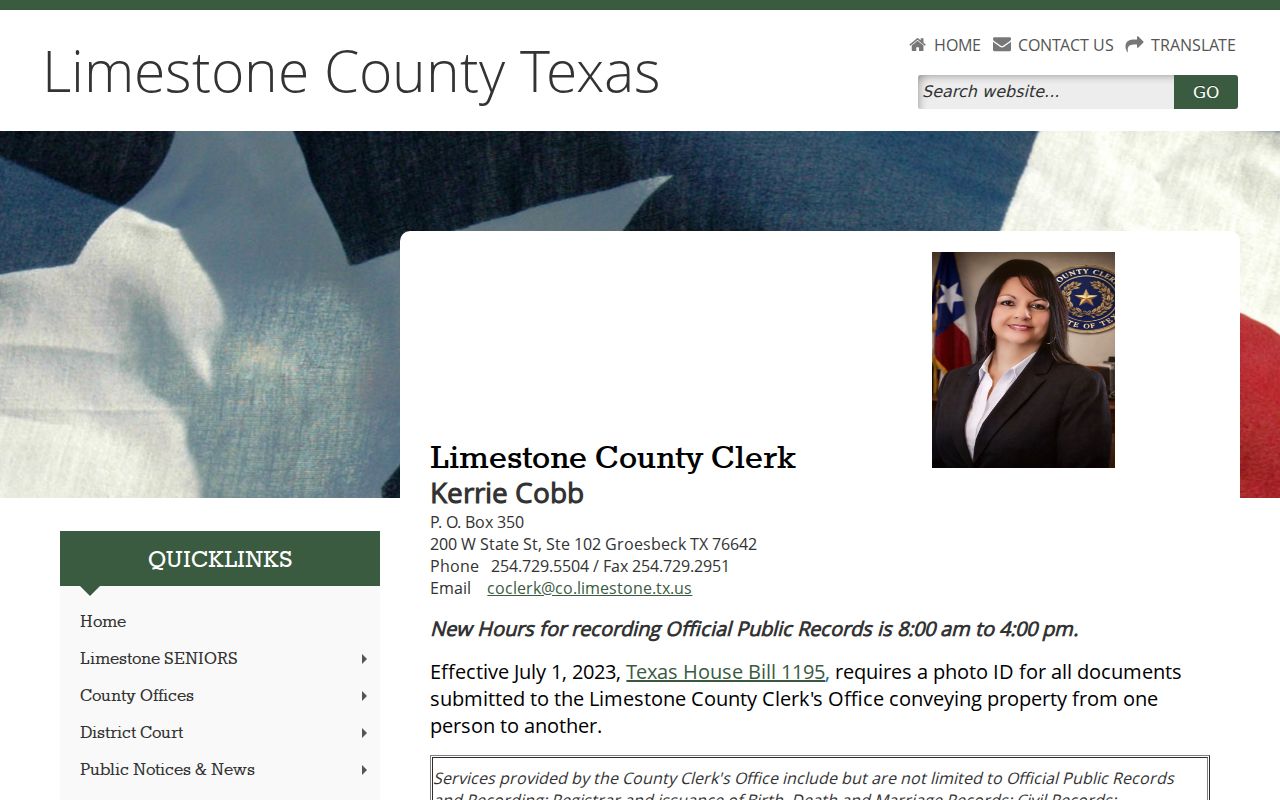
The clerk page ties the Limestone County criminal docket to the office that can tell a setting, a transaction record, and a filed judgment apart. Contact also works as an access path when a portal login fails.
Which Court Holds Criminal Dockets
Limestone County splits criminal custody by jurisdiction. The County Clerk files Class A and B misdemeanors. Class C matters appealed from justice or municipal court go there too. That office also handles process for its cases, such as warrants, summonses, subpoenas, bond forfeitures, and commitments. Felony and other district criminal files go to the District Clerk. That office serves the 77th and 87th District Courts. The District Clerk's online payment site offers no public docket search. For the authoritative register and copy route, call 254-729-3206 or visit the courthouse, Suite 206.
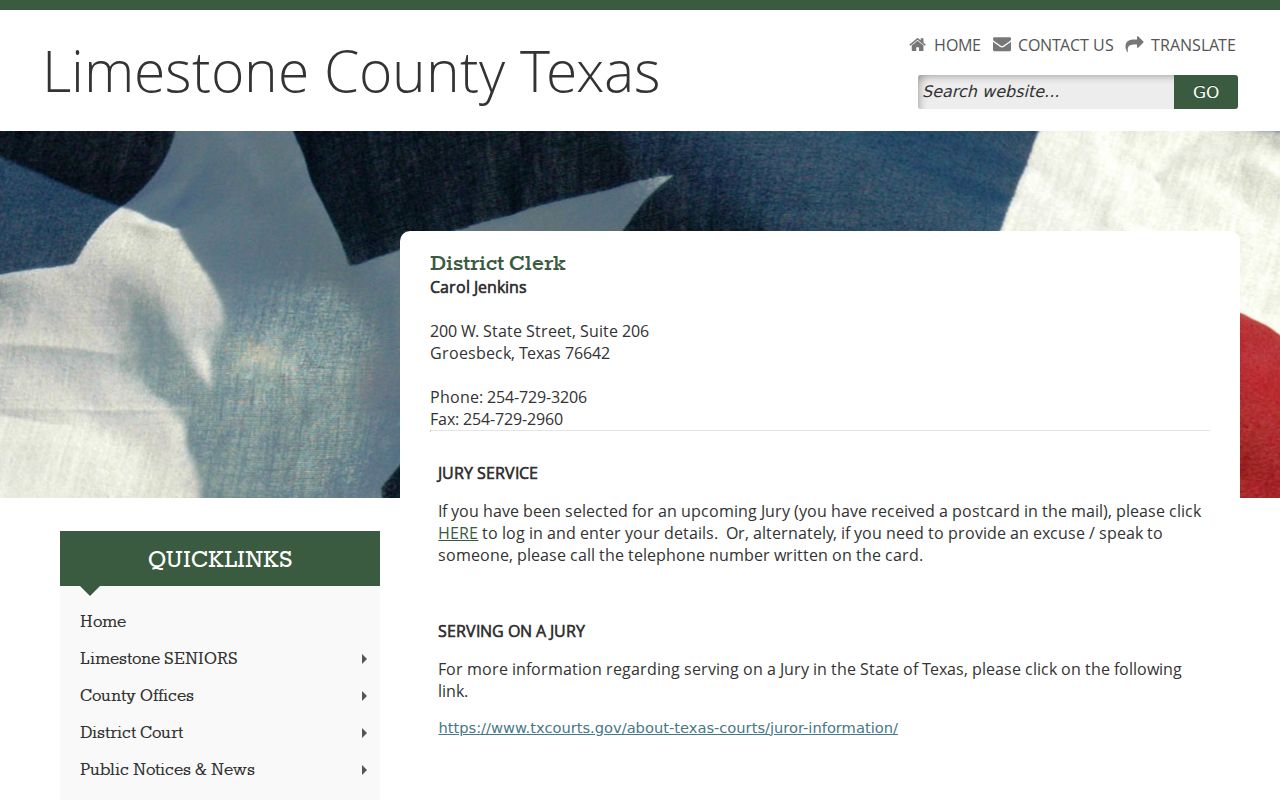
The District Clerk page marks the local doorway for district criminal docket questions. The County Clerk remains the county misdemeanor custodian.
Limestone Criminal E-Filing Route
eFileTexas active-court data marks Limestone County criminal e-filing as mandatory. E-filing lets an authorized filer submit a document. It is not the same as public access to every docket entry. Once accepted, a filing becomes part of the court record, subject to access rules. re:SearchTX can add a statewide research layer when the court is integrated and access allows it, though account, price, and coverage vary. Texas has no single universal trial-court portal, so confirming with the local clerk remains vital.
Limestone Criminal Docket Requests
A docket line rarely tells you how a Limestone County criminal case came out. Ask the clerk for something specific instead. Try a judgment, a disposition order, or another named document. Name the court and the cause number too. Say what form you want: inspection, an electronic copy, paper, or a certified copy. Give the date range too. A phone number and return email let staff clarify the scope or send a fee estimate.
A misdemeanor case in County Court goes to the County Clerk. That office sits at 200 W State Street, Suite 102, Groesbeck, or call 254-729-5504. A felony or district criminal file belongs to the District Clerk. Criminal-history reports from the Texas Department of Public Safety are separate records. They are not Limestone County court files. The Texas Judicial Branch records information draws that line. It sends court documents back to the local clerks.
Keep the scope tight. Staff can then spot the exact document and the right office fast. If something sealed or restricted cannot be released, ask what rule controls access. Also ask whether a public docket shell or a redacted copy still exists. Save the reply with your search notes. A calendar printout is never the whole case.
Read Limestone Criminal Status Terms
Short labels are easy to overread. Keep each entry in its procedural place.
- Setting
- A scheduled event, not an outcome.
- Continuance
- A postponement or reset.
- Motion to revoke probation
- A request about an alleged violation, not a ruling.
- Disposed
- A closed-status label; obtain the judgment for the result.
- Expunction
- A legal process governed by Texas law.
A charge on a Limestone County criminal docket is only an allegation the court has received. It proves nothing about guilt. Bond information simply records release conditions, and it says nothing about a conviction or a sentence.
Public Access and Sealed Criminal Dockets
Plenty of Limestone County criminal docket entries are open to the public. Still, access has real limits. The Texas Judicial Branch routes trial-court case requests to the office that actually holds the file: the county clerk, district clerk, justice court, or municipal court. OCA keeps none of the individual county files itself. Juvenile records, sealed cases, and expunged material stay out of any ordinary docket portal.
Key access rules:
Code of Criminal Procedure Chapter 55 governs expunction.
Family Code Chapter 58 addresses juvenile record access.
Texas Open Records Policy explains court case records and other judicial records.
An empty search result does not mean the case is gone. A miss can come from searching the wrong court, a name or number mismatch, slow data integration, or a record the law keeps closed. When you contact the clerk, provide the court, the case number, a date range, the document you need, and how you want the copy.